


Close-Up Lens Kit +1+2+4+10
So you're curious about macro photography. You've seen those incredible close-up shots of insects, flowers, and tiny details, and you want to try it yourself. But where do you start? A dedicated macro lens can cost a small fortune. Extension tubes are great, but they require removing and swapping parts. What if there was a simpler, more complete solution?
There is. Meet the Close-Up Lens Kits.
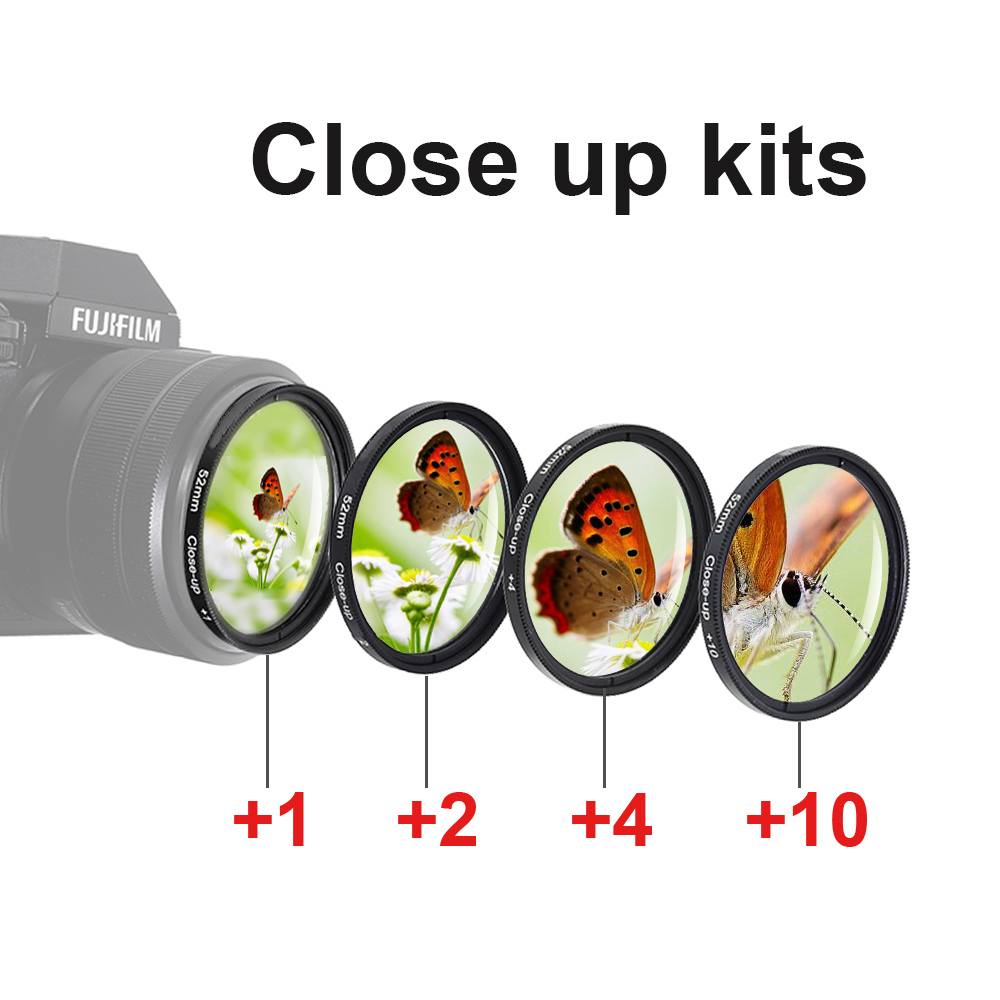
Take a look at this lineup. We're talking about complete kits that include four different strengths—+1, +2, +4, and +10—all in one package. Available in sizes from 37mm to 82mm (LC5310 to LC5309) , these kits give you everything you need to explore the miniature world, right out of the box.
| P/N | Description | Compatible Accessories | Remark |
| LC5310 | Close-up Kits for 37mm(+1+2+4+10) | Ø 37mm lens | Material: Optical glass + Aluminum Alloy Frame |
| LC5312 | Close-up Kits for 39mm(+1+2+4+10) | Ø 39mm lens | Material: Optical glass + Aluminum Alloy Frame |
| LC5313 | Close-up Kits for 40.5mm(+1+2+4+10) | Ø 40.5mm lens | Material: Optical glass + Aluminum Alloy Frame |
| LC5314 | Close-up Kits for 43mm(+1+2+4+10) | Ø 43mm lens | Material: Optical glass + Aluminum Alloy Frame |
| LC5301 | Close-up Kits for 46mm(+1+2+4+10) | Ø 46mm lens | Material: Optical glass + Aluminum Alloy Frame |
| LC5311 | Close-up Kits for 49mm(+1+2+4+10) | Ø 49mm lens | Material: Optical glass + Aluminum Alloy Frame |
| LC5302 | Close-up Kits for 52mm(+1+2+4+10) | Ø 52mm lens | Material: Optical glass + Aluminum Alloy Frame |
| LC5303 | Close-up Kits for 55mm(+1+2+4+10) | Ø 55mm lens | Material: Optical glass + Aluminum Alloy Frame |
| LC5304 | Close-up Kits for 58mm(+1+2+4+10) | Ø 58mm lens | Material: Optical glass + Aluminum Alloy Frame |
| LC5305 | Close-up Kits for 62mm(+1+2+4+10) | Ø 62mm lens | Material: Optical glass + Aluminum Alloy Frame |
| LC5306 | Close-up Kits for 67mm(+1+2+4+10) | Ø 67mm lens | Material: Optical glass + Aluminum Alloy Frame |
| LC5307 | Close-up Kits for 72mm(+1+2+4+10) | Ø 72mm lens | Material: Optical glass + Aluminum Alloy Frame |
| LC5308 | Close-up Kits for 77mm(+1+2+4+10) | Ø 77mm lens | Material: Optical glass + Aluminum Alloy Frame |
| LC5309 | Close-up Kits for 82mm(+1+2+4+10) | Ø 82mm lens | Material: Optical glass + Aluminum Alloy Frame |
Why a Kit? Because One Strength Isn't Enough.
Here's the thing about close-up photography: different subjects need different magnification. A tiny ant requires more power than a flower petal. A watch mechanism needs different magnification than a butterfly wing. With a kit, you're prepared for all of it.
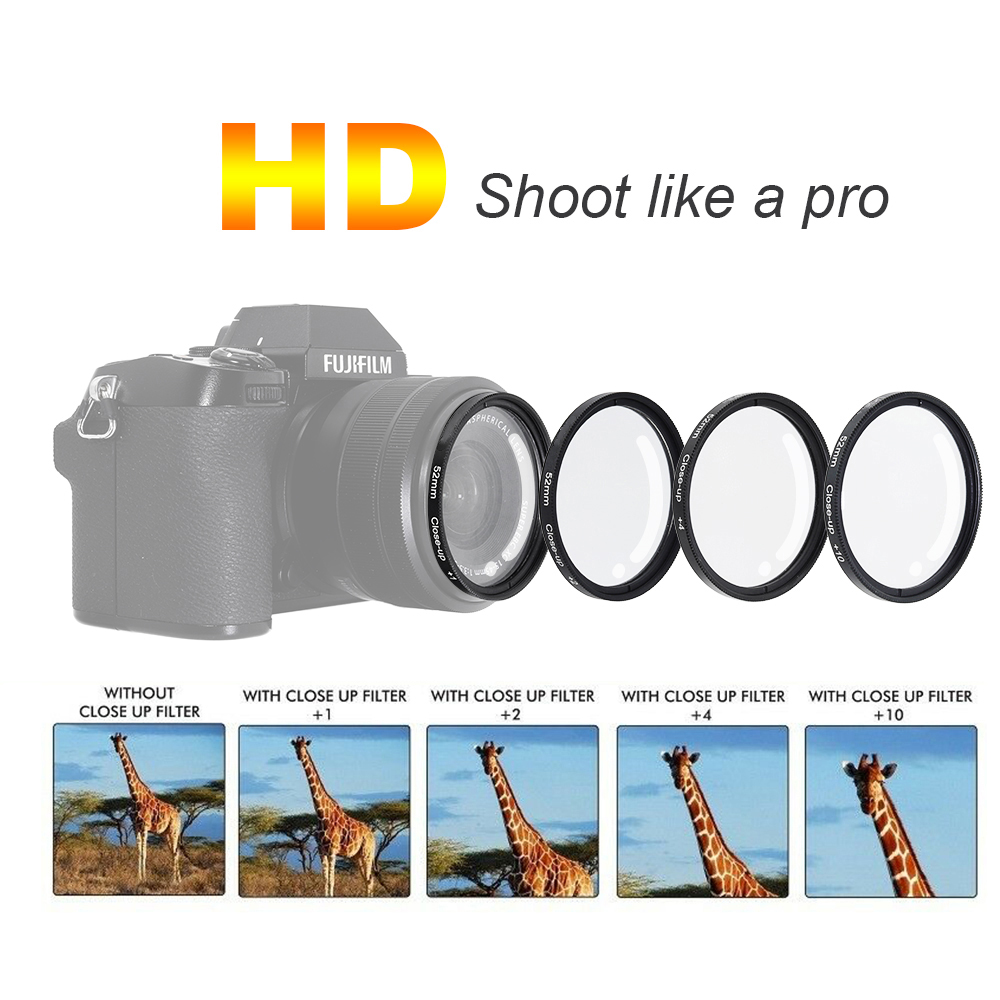
+1: Gentle magnification. Perfect for larger flowers, product details, or adding a subtle close-up effect to portraits.
+2: Moderate power. Great for smaller flowers, leaves, and general nature close-ups.
+4: Strong magnification. Ideal for insects, coins, stamps, and detailed textures.
+10: Serious macro territory. This gets you extremely close—think tiny insect eyes, the veins on a leaf, or intricate mechanical details.
And here's the bonus: you can stack them. Combine +2 and +4 to get +6. Stack +1 and +10 for +11. The combinations are endless. One kit gives you a whole range of macro possibilities.
What's in the Kit?
Each kit contains four individual close-up lenses, all built with optical glass in aluminum alloy frames. That's quality you can count on. Optical glass means sharp, clear images—not the blurry mess you get from cheap plastic alternatives. The aluminum frames are lightweight yet durable, ready for years of use.
Let's get a quick view of what you may concern:
Q: Why would I buy a kit instead of just one close-up lens?
A: Great question. A single lens gives you one magnification level. A kit gives you four (plus all the combinations you can create by stacking). You'll quickly find that different subjects need different approaches. A +2 might be perfect for flowers, but insects might need +4 or +10. Having the whole set means you're ready for anything. Plus, buying them together in a kit is almost always more affordable than buying them separately.
Q: How do I know which strength to use?
A: Start with the lowest strength (+1) and work your way up. See how close you can get. If you want more magnification, try the +2. Still not enough? Move to +4 or +10. You'll develop an instinct for it. For beginners, the +2 and +4 are great all-around starting points. Save the +10 for when you want to get really, really close.
Q: Can I stack these lenses together?
A: Yes! Screw one into another to combine strengths. For example, +2 stacked with +4 gives you +6 magnification. +1 with +10 gives you +11. Just be aware that stacking adds thickness, which can slightly increase the risk of vignetting (dark corners) on some lenses. Experiment and see what works for your setup.
Q: Will these fit my lens?
A: Check your lens for the"Ø"symbol followed by a number—like Ø 58mm. That's your filter thread size. Match it to the kit size (e.g., LC5304 for 58mm). If your lens has that size, these will screw right on.
Q: Do I need to use a tripod?
A: Not always, but it helps. At high magnifications (like +4 or +10), even tiny movements can throw off your focus. A tripod gives you stability and makes it easier to compose your shot. For lower strengths (+1, +2) in good light, you can often shoot handheld. But for serious macro work, a tripod is your friend.
Q: Will autofocus still work?
A: Yes, autofocus will function normally. However, at very close distances, depth of field becomes extremely shallow. Many macro photographers prefer to switch to manual focus for precise control over exactly what's sharp. Try both and see what works for you.
Q: Will these affect image quality?
A: These are made with optical glass, so the impact on image quality is minimal—especially compared to cheap plastic lenses. You'll get sharp, clear results. Like any accessory lens, there might be a slight softness at the extreme edges at higher magnifications, but for most subjects, it's barely noticeable. The quality-to-price ratio is excellent.
Q: Can I use these with other filters, like a CPL or UV?
A: You can, but be careful about stacking too much. Adding a close-up lens on top of a UV filter, for example, increases the distance from your main lens and can affect image quality. For best results, use the close-up lenses directly on your lens. If you need protection, consider a lens hood instead of stacking filters.
Q: What's the best way to store these when not in use?
A: Keep them in their original packaging or a padded case. The optical glass is durable, but scratches are still possible. A soft microfiber cloth is great for cleaning. Avoid tossing them loosely in a bag where they can rub against keys or other gear.
Q: Are these better than extension tubes for macro?
A: Both have their strengths. Extension tubes are hollow—they don't add glass, so they don't affect optical quality. But they require removing and attaching between your lens and camera, which can be fiddly. Close-up lenses screw on like filters—quick and easy. They're also more portable. Which is"better"depends on your preference. Many photographers own both!
If you want to explore macro photography without breaking the bank, a close-up lens kit is the perfect starting point. You get four strengths, endless stacking combinations, and quality optical glass construction—all in one package. Whether you're shooting flowers, insects, coins, or tiny details, you'll have the right tool for the job.
Find your lens size, grab a kit, and start discovering the incredible detail hiding in plain sight. The miniature world is waiting.


