


Male to Male Thread Adapter Ring
What is this"Double Male"thing?
Let's break it down. In photography,"male"threads are the ones on the outside of a tube (like those on the front of a lens). A"female"thread is on the inside of a hole (like a filter screws into). A standard adapter usually has a female thread on one side and a male on the other.
A Double Male Adapter Ring is different. It has male threads on BOTH ends. It's literally just a short tube with threads on the outside at each end.
Let's have a quick view for the available sizes in LingoFoto:
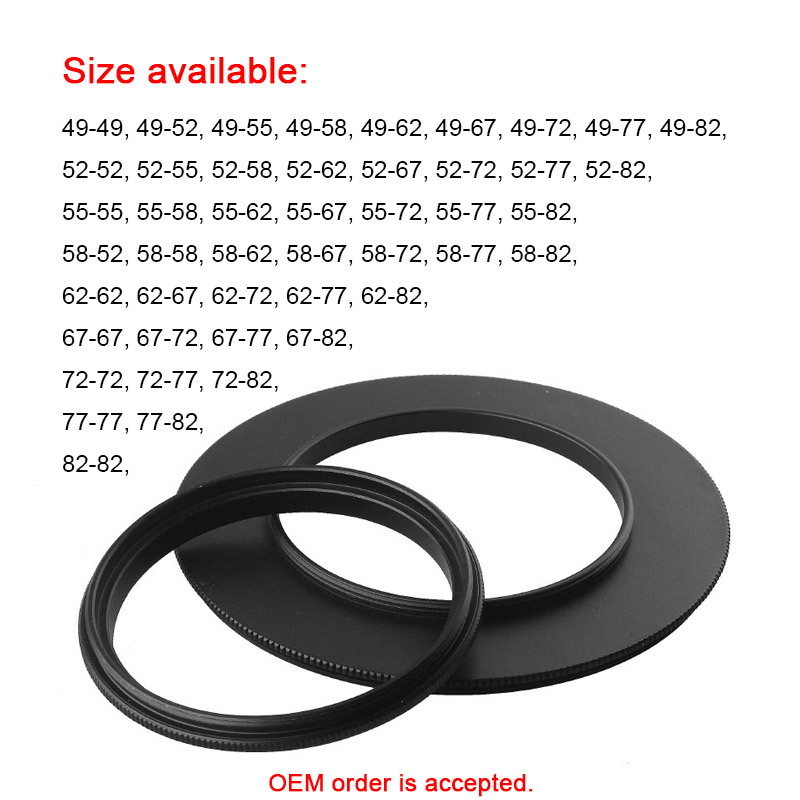
| P/N | Description | Male Thread | Male Thread |
| LC1742 | M48x0.75mm Male to M42x0.75mm Male Adapter Ring | 48mm | 42mm |
| LC8401 | Male to Male Adapter for 49-49mm | 49mm | 49mm |
| LC8402 | Male to Male Adapter for 49-52mm | 49mm | 52mm |
| LC8403 | Male to Male Adapter for 49-55mm | 49mm | 55mm |
| LC8404 | Male to Male Adapter for 49-58mm | 49mm | 58mm |
| LC8405 | Male to Male Adapter for 49-62mm | 49mm | 62mm |
| LC8406 | Male to Male Adapter for 49-67mm | 49mm | 67mm |
| LC8408 | Male to Male Adapter for 49-77mm | 49mm | 77mm |
| LC8409 | Male to Male Adapter for 49-82mm | 49mm | 82mm |
| LC8410 | Male to Male Adapter for 52-52mm | 52mm | 52mm |
| LC8411 | Male to Male Adapter for 52-55mm | 52mm | 55mm |
| LC8412 | Male to Male Adapter for 52-58mm | 52mm | 58mm |
| LC8413 | Male to Male Adapter for 52-62mm | 52mm | 62mm |
| LC8414 | Male to Male Adapter for 52-67mm | 52mm | 67mm |
| LC8415 | Male to Male Adapter for 52-72mm | 52mm | 72mm |
| LC8416 | Male to Male Adapter for 52-77mm | 52mm | 77mm |
| LC8417 | Male to Male Adapter for 52-82mm | 52mm | 82mm |
| LC8418 | Male to Male Adapter for 55-55mm | 55mm | 55mm |
| LC8419 | Male to Male Adapter for 55-58mm | 55mm | 58mm |
| LC8420 | Male to Male Adapter for 55-62mm | 55mm | 62mm |
| LC8421 | Male to Male Adapter for 55-67mm | 55mm | 67mm |
| LC8422 | Male to Male Adapter for 55-72mm | 55mm | 72mm |
| LC8423 | Male to Male Adapter for 55-77mm | 55mm | 77mm |
| LC8424 | Male to Male Adapter for 55-82mm | 55mm | 82mm |
| LC8446 | Male to Male Adapter for 58-52mm | 58mm | 52mm |
| LC8425 | Male to Male Adapter for 58-58mm | 58mm | 58mm |
| LC8426 | Male to Male Adapter for 58-62mm | 58mm | 62mm |
| LC8427 | Male to Male Adapter for 58-67mm | 58mm | 67mm |
| LC8428 | Male to Male Adapter for 58-72mm | 58mm | 72mm |
| LC8429 | Male to Male Adapter for 58-77mm | 58mm | 77mm |
| LC8430 | Male to Male Adapter for 58-82mm | 58mm | 82mm |
| LC8431 | Male to Male Adapter for 62-62mm | 62mm | 62mm |
| LC8432 | Male to Male Adapter for 62-67mm | 62mm | 67mm |
| LC8433 | Male to Male Adapter for 62-72mm | 62mm | 72mm |
| LC8434 | Male to Male Adapter for 62-77mm | 62mm | 77mm |
| LC8435 | Male to Male Adapter for 62-82mm | 62mm | 82mm |
| LC8436 | Male to Male Adapter for 67-67mm | 67mm | 67mm |
| LC8437 | Male to Male Adapter for 67-72mm | 67mm | 72mm |
| LC8438 | Male to Male Adapter for 67-77mm | 67mm | 77mm |
| LC8439 | Male to Male Adapter for 67-82mm | 67mm | 82mm |
| LC8440 | Male to Male Adapter for 72-72mm | 72mm | 72mm |
| LC8441 | Male to Male Adapter for 72-77mm | 72mm | 77mm |
| LC8442 | Male to Male Adapter for 72-82mm | 72mm | 82mm |
| LC8443 | Male to Male Adapter for 77-77mm | 77mm | 77mm |
| LC8444 | Male to Male Adapter for 77-82mm | 77mm | 82mm |
| LC8445 | Male to Male Adapter for 82-82mm | 82mm | 82mm |
| LC8447 | Male to Male Adapter for 77-58mm | 77mm | 58mm |
What's it for? (The Main Uses)
It's your go-to tool for two main jobs:
Connecting Filters to Lenses (The Most Common Use): This is its superpower. Let's say you have a great 67mm UV filter, but your new, awesome lens has a 77mm thread size. Instead of buying a whole new 77mm filter, you get a 67mm to 77mm Male-Male Adapter (like LC8432). You screw your 67mm filter into one end of the adapter, and then screw the other end of the adapter into your 77mm lens. Boom! Problem solved, money saved.
Connecting Two Lenses Face-to-Face (For Macro!): This is a cool, old-school trick for extreme close-up (macro) photography. You use the ring to screw the filter threads of two lenses together (one facing normally, the other reversed). The reversed lens acts as a powerful magnifying glass. This is a very niche but fun creative use.
Forget the part number for a second. Just remember this simple formula:
Step 1: Identify the FIRST male thread.
This is the thread size of the thing you're attaching TO the ring (usually your filter). Look for the"ø"symbol or"mm"number on your filter's rim (e.g., ø67mm).
Step 2: Identify the SECOND male thread.
This is the thread size of the thing you're attaching the ring TO (usually your lens). Find the same number near your lens's front element (e.g., ø77mm).
Step 3: Find the matching adapter.
You need an adapter where:
Male Thread 1 = Your FILTER size
Male Thread 2 = Your LENS size
Example from your list: You have a 62mm filter and a 67mm lens. Look for the adapter where the"Male Thread"columns are 62mm and 67mm. That's LC8432.
Special Case: If your lens and filter are the same size (e.g., both 77mm), you just need a simple"dummy"coupling ring of the same size, like LC8443 (77-77mm).
👍 Advantages:
Cost-Effective: One adapter lets you use your existing filters on many different lenses. No need to buy the same filter in multiple sizes.
Saves Space: A tiny metal ring is much easier to carry than multiple large filters.
Creative Potential: Enables the DIY macro"lens reversing"technique.
👎 Disadvantages / Warnings:
Potential for Vignetting (Dark Corners): This is the biggest risk! If you're connecting a small filter to a much larger lens, the adapter acts like a tube. This can block light and cause black corners in your photos, especially on wide-angle lenses. The greater the size difference, the higher the risk.
Extra Bulk: It adds a bit of length to your lens+filter setup.
Not for Stepping Down Drastically: Avoid using it to mount a very large filter onto a very small lens—it usually doesn't work physically and almost always causes bad vignetting.
A good quality, well-made metal ring itself will not. The main risk is vignetting (dark corners), as explained above. Optical quality depends on your filter, not the ring.
A: That's the pitch – the distance between the threads. For standard camera filter/lens threads, it's almost always 0.75mm. Just make sure the millimeter (mm) size matches; the pitch will almost certainly be correct for photo gear. (This is more critical for specialized industrial or cine parts).
A: Technically yes, but it's a bad idea. Each one adds length and increases the chance of vignetting, wobble, and difficulty attaching lens caps. Try to use a single, correctly sized adapter.
A: NO! ABSOLUTELY NOT! This is only for connecting filter-sized threads on the front of equipment. It has nothing to do with the large, complex lens mount (EF, RF, Z, E, etc.) that connects the lens to the camera body. Using it for that will damage your gear.
A: The ring is symmetrical, so it doesn't matter mechanically. Just be gentle when screwing everything together to avoid cross-threading. Always screw your filter onto the adapter first, then attach the assembly to the lens for better control.


