


Macro Extension Bellows
Ever wanted to get crazy close to your subject? I mean, "see the individual hairs on a bee's leg" close? Regular macro lenses are great, but they have limits. That's where the Macro Bellows comes in. Think of it as a stretchy, accordion-like tube that pushes your lens further away from your camera to achieve mind-blowing magnification.
It's like the ultimate macro accessory for photographers who want to push beyond 1:1 life-size magnification.
Then What Is a Macro Bellows?
It's a mechanical device that fits between your camera body and lens. Unlike fixed-length extension tubes (which are just hollow rings), a bellows has a flexible, accordion-style middle section. You can slide it back and forth on a rail to continuously and precisely adjust the distance—and therefore the magnification power. It's manual focus at its most tactile.
What's It For?
Extreme Macro Photography: This is its main gig. When you need magnification greater than 1:1 (where the subject is larger on your sensor than in real life). Perfect for photographing insects' eyes, snowflakes, tiny circuit boards, or the texture of a butterfly's wing.
High-Precision Magnification Control: Need a specific, repeatable magnification for product or scientific work? The fine-tuning knob on a bellows lets you dial it in exactly and lock it down.
Using Vintage Lenses for Macro: It's a fantastic way to breathe new life into a great old manual lens, turning it into a dedicated macro tool.
| P/N | Description | Compatible Camera |
| LC8170 | Macro Entension Bellows Focusing for NIK D/G Lens;With 2 Metal Pipes | Nikon F Mount Camera |
| LC8171 | Macro Entension Bellows Focusing for CN. EOS/EF;With 2 Metal Pipes | Canon EOS EF Mount Camera |
| LC8172 | Macro Entension Bellows Focusing for SN. AF/MA;With 2 Metal Pipes | Sony A-mount/Minolta A-mount Camera |
| LC8173 | Macro Entension Bellows Focusing for SN. NEX;With 2 Metal Pipes | Sony E Mount Camera |
| LC8174 | Macro Entension Bellows Focusing for SN. NEX;With 1 Plastic Pipe | Sony E Mount Camera |
👍 Advantages:
Insane Magnification: Achieves much higher magnification than standard macro lenses or extension tubes.
Continuous, Precise Control: Smooth, stepless adjustment. Find the exact framing you want.
Often Better Optical Quality: By using a high-quality normal or short telephoto lens (reversed or not) on a bellows, you can sometimes get better corner-to-corner sharpness at high magnifications than with some dedicated macro lenses.
👎 Disadvantages:
You Lose a LOT of Light: Extending the bellows significantly reduces the light reaching your sensor. You'll need a lot of light, a tripod, and often focus stacking.
Fully Manual Operation: No autofocus (it's useless at these magnifications anyway). For modern electronic lenses, you'll lose automatic aperture control and EXIF data unless you get a very expensive model with electronic contacts (like LC8171 for Canon EF might offer).
Bulky and Delicate: It's not a"walk-around"tool. It's a studio/field-station setup. The bellows material is also sensitive to dust and damage.
Complex Calculations: Figuring out exposure compensation and magnification takes some math
How to Pick the Right One & How It Works
1. Match Your Camera Mount!
This is the most critical step. You must choose a bellows with the correct mount for your camera.
LC8171 = Canon EOS/EF
LC8170 = Nikon D/G (likely with mechanical aperture lever)
LC8172 = Sony A-mount
LC8173/LC8174 = Sony E-mount (NEX)
2. Understand Magnification:
The rule of thumb is: Magnification ≈ Bellows Extension / Lens Focal Length.
Example: A 100mm lens on a 150mm extended bellows gives you roughly 1.5:1 magnification (the subject is 1.5x life-size on your sensor).
Warning: This is why bellows work best with shorter lenses (50mm, 100mm). A 300mm lens would need a 300mm long bellows to reach 1:1—impractical!
3. Connection Method:
You attach it just like an extension tube:
Camera Body ➜ Bellows (mounted to camera mount) ➜ Lens (mounted to the front standard of the bellows).
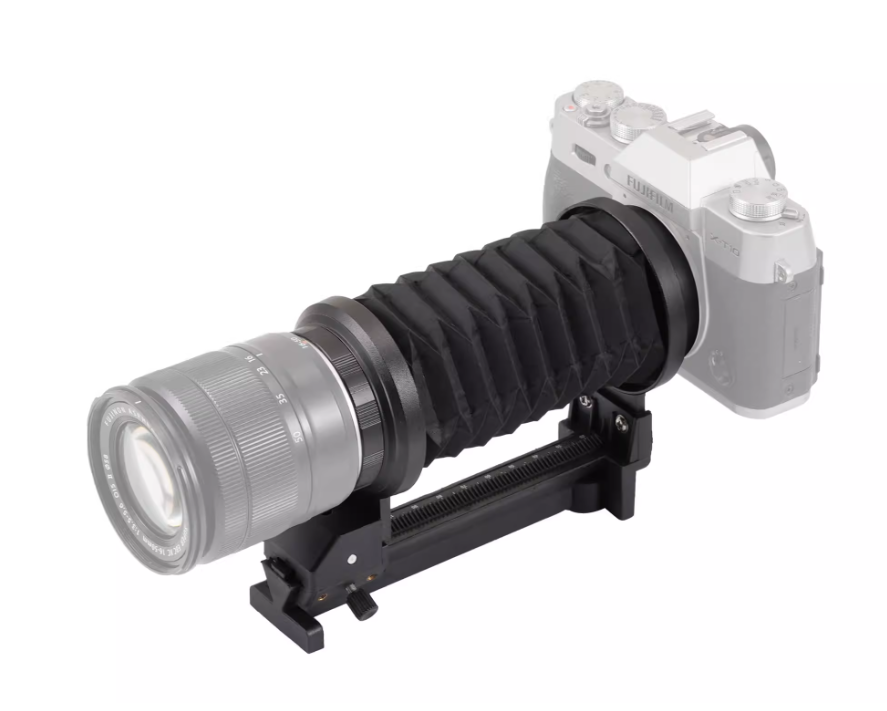
Extension Tubes are fixed-length, giving you set magnification"steps."A Bellows offers continuous, smooth adjustment between its minimum and maximum length. It's the difference between a fixed wrench and a adjustable wrench.
The anwer is No, but some work better. Normal prime lenses (50mm) are great. You can even mount a lens in reverse (using a reversing ring) on the front of the bellows for even higher magnification and often better optical performance.
Forget it. At these magnifications, focusing is done by minutely moving the entire camera setup back and forth on the rail or using the fine-tuning knob. You focus with the aperture wide open for brightness, then stop down to shoot.
Physics! You're dramatically increasing the distance light has to travel from the lens to the sensor. The effective aperture gets much smaller. Exposure compensation is mandatory. A rough formula: Exposure Factor = (1 + Magnification)². If you're at 2:1 magnification, you need (1+2)² = 9 times more light (that's about +3 stops).
This is the big divide.
Inexpensive Bellows (like most listed): Usually NO electronic linkage. You must use manual lenses, or with modern lenses, the aperture will be stuck wide open unless the lens has a manual aperture ring. Camera metering may not work.
High-End/Original Brand Bellows: Have electronic contacts, allowing aperture control and sometimes metering with AF lenses, but they cost a fortune
"2 Metal Pipes" refers to the support rails. Metal rails are sturdier, more stable, and more precise—crucial for sharp macro work. The plastic version is a more budget-friendly, but potentially less rigid, option.


