


Female to Female Adapter Ring
You know step-up/down rings, right? Those little guys that make filters fit lenses.But have you seen a ring that's threaded on the inside at both ends? Outside is smooth. Looks like a tiny pipe.
That's the Double Female Ring.
It might seem useless at first. But in certain setups? Total game-changer. Let's break down what it does, when you'd use it, and why some shooters swear by it.
Let's have a quick view of available size in LingoFoto.
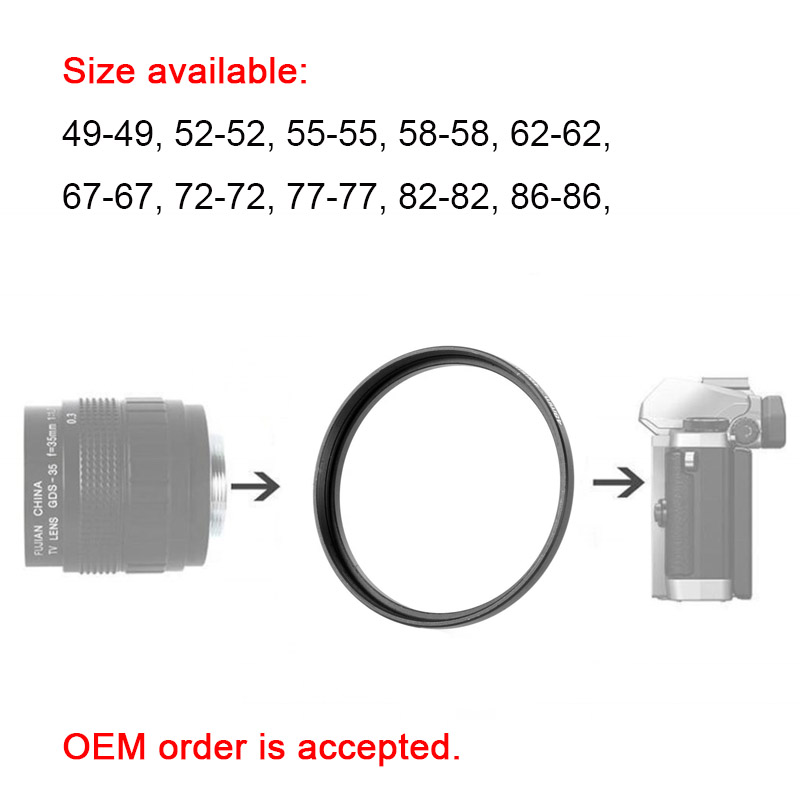
| P/N | Description | Female Thread | Female Thread |
| LC8451 | Female to Female Ring Adapter for 49-49mm | 49mm | 49mm |
| LC8452 | Female to Female Ring Adapter for 52-52mm | 52mm | 52mm |
| LC8453 | Female to Female Ring Adapter for 55-55mm | 55mm | 55mm |
| LC8454 | Female to Female Ring Adapter for 58-58mm | 58mm | 58mm |
| LC8455 | Female to Female Ring Adapter for 62-62mm | 62mm | 62mm |
| LC8456 | Female to Female Ring Adapter for 67-67mm | 67mm | 67mm |
| LC8457 | Female to Female Ring Adapter for 72-72mm | 72mm | 72mm |
| LC8458 | Female to Female Ring Adapter for 77-77mm | 77mm | 77mm |
| LC8459 | Female to Female Ring Adapter for 82-82mm | 82mm | 82mm |
| LC8460 | Female to Female Ring Adapter for 86-86mm | 86mm | 86mm |
What Is It?
Think of it as a short tube or spacer with female threads (the grooves on the inside) on both ends. It's the exact opposite of a"double male"(coupling) ring. Its entire job is to connect two items that each have male threads (the threads on the outside).
Visualize it: It’s like a tiny nut that joins two bolts together, but for your camera gear.
What's It For? (Main Uses & Scenarios)
This isn't an everyday item for everyone, but when you need it, it's a lifesaver.
Primary Use: Creating a Front"Filter Thread Hub"or Spacer.
This is the most common professional use. You screw the double female ring onto the front of a lens or another accessory (which has male threads). This now creates a new, extended front end with female threads. Why would you do this?To Use a Larger Filter/Attachment: Sometimes, adding a thick filter (like a variable ND) or a matte box directly to a lens can cause vignetting (dark corners) because it's too close to the front element. This ring acts as a spacer, moving the filter farther forward to eliminate the vignette.
To Standardize Filter Sizes: If you have multiple lenses with different thread sizes (e.g., 67mm, 72mm), but you want to use one large, expensive filter (like a 77mm polarizer) on all of them, you can use step-up rings. A double female ring can sometimes be part of a secure stacking system to hold this setup together, especially with heavy filters.
Specialized Use: Connecting Two Male-Threaded Items.
Need to securely connect two accessories that both have male threads? This is your connector. A classic example in some rig setups is connecting certain types of lens hoods or sunshades to other support gear.
Here are the"Good"And"Watch Out"
The Good Stuff (Pros):
Solves Vignetting: Its primary superpower is fixing corner shadows caused by stacked filters or accessories.
Enables Rig Building: A crucial, small part for building custom camera rigs and stabilizing complex filter setups.
Adds Security: When used in a filter stack, it can help lock everything in place and prevent accidental unscrewing.
The Watch-Outs (Cons):
Very Specific Use Case: It's not a general-purpose tool like a step-up ring. Most hobbyists will never need one.
Adds Length & Bulk: It makes your lens setup longer, which might be an issue for storage or balance.
Quality is Key: A poorly machined, low-quality double female ring can get cross-threaded easily, potentially damaging the expensive male threads on your lens or filter.
How to Choose the Right One
This is the easiest part! You only need to know one number.
Look at the item you want to attach the ring TO (usually your lens or the first filter). Find its male thread size (e.g., 77mm). Then, look at your product list.
You need a ring where BOTH"Female Thread"sizes match that number.
Example: Your lens has a 77mm front thread.
You look for the adapter where both Female Thread columns say 77mm.
That is LC8458.
Rule of Thumb: From your list, these are all"same-size"adapters (49-49, 77-77, etc.). This means they are designed to connect two items of the identical thread size. They are spacers/hubs, not for changing sizes.
But is this the same as a"step-up"or"step-down"ring?
No, absolutely not. A step-up ring has a female thread (to attach to lens) and a larger male thread (to hold a bigger filter). A step-down ring has a female thread and a smaller male thread. The Double Female ring has no male threads at all. It does not change the filter size; it provides a new port of the same size, but farther forward.
Can I use it to connect a 77mm filter to a 67mm lens?
No, you cannot. That is the job of a step-up ring (67mm female to 77mm male). This ring requires both connected parts to have the same male thread size.
Why does the product list only show sizes like 49-49mm and 77-77mm?
Because its core function is to be a spacer or hub for the same size. It's meant to extend the front of a 77mm lens so you can still use 77mm filters without vignetting, not to adapt between 67mm and 77mm.
What's the main thing to check before buying?
1) The male thread size of your lens/filter. 2)The thread pitch (usually 0.75mm for photo gear). Make sure the ring's stated size matches perfectly. Using a 0.75mm pitch ring on gear with a different pitch (e.g., 1.0mm) will damage the threads.
Is there a risk of light leak with this extra ring?
A: If it's a well-made, black-anodized metal ring that screws on snugly, the risk is minimal. The issue it solves (vignetting) is usually a bigger problem than potential light leak from a small seam.
The Double Female Ring Adapter is a niche problem-solver. It's for the photographer or videographer who needs to push their filters forward to avoid dark corners or build a secure, custom front-end setup. If you're dealing with vignetting from stacked filters or building a professional rig, this little ring might be your secret weapon. Just make sure you get the exact thread size to match your gear.


