


CPL Filter for DSLR
You've probably been there. You're shooting a beautiful landscape, and the sky looks washed out. Or you're trying to photograph a lake, but the surface is so reflective you can't see through to the water. Maybe you've taken photos through a window and ended up with nothing but glare.
There's a simple solution to all of these problems, and it screws right onto the front of your lens. Meet the CPL filter—short for Circular Polarizer.
Take a look at this lineup.
| P/N | Description | Compatible Accessories | Remark |
| LC5201 | CPL Filter for 37mm | all accessories with Ø 37mm thread | Material: Optical glass+Aluminum Frame Non coating, non waterproof |
| LC5215 | CPL Filter for 39mm | all accessories with Ø 39mm thread | |
| LC5212 | CPL Filter for 40.5mm | all accessories with Ø 40.5mm thread | |
| LC5213 | CPL Filter for 43mm | all accessories with Ø 43mm thread | |
| LC5202 | CPL Filter for 46mm | all accessories with Ø 46mm thread | |
| LC5203 | CPL Filter for 49mm | all accessories with Ø 49mm thread | |
| LC5204 | CPL Filter for 52mm | all accessories with Ø 52mm thread | |
| LC5205 | CPL Filter for 55mm | all accessories with Ø 55mm thread | |
| LC5206 | CPL Filter for 58mm | all accessories with Ø 58mm thread | |
| LC5207 | CPL Filter for 62mm | all accessories with Ø 62mm thread | |
| LC5208 | CPL Filter for 67mm | all accessories with Ø 67mm thread | |
| LC5209 | CPL Filter for 72mm | all accessories with Ø 72mm thread | |
| LC5210 | CPL Filter for 77mm | all accessories with Ø 77mm thread | |
| LC5211 | CPL Filter for 82mm | all accessories with Ø 82mm thread | |
| LC5217 | CPL Filter for 86mm | all accessories with Ø 86mm thread | |
| LC5214 | CPL Filter for 95mm | all accessories with Ø 95mm thread | |
| LC5216 | CPL Filter for 105mm | all accessories with Ø 105mm thread |
We're covering just about every size you could need, from 37mm all the way up to 105mm (LC5201 to LC5216) . Whether you're shooting with a compact camera via an adapter tube, a classic prime lens, or a professional telephoto, there's a CPL here that will fit.
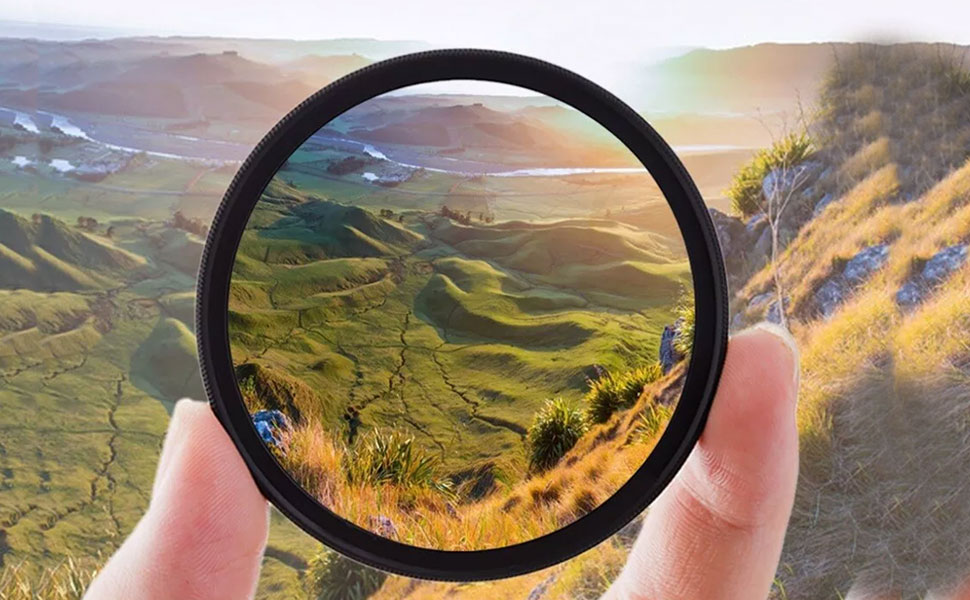
So, What Exactly Does a CPL Do?
Great question. A CPL filter is like a pair of polarized sunglasses for your camera. It works by blocking certain light waves that cause glare and reflections. But unlike sunglasses, you can rotate it to control exactly how much of that effect you want.
Here's what it helps you do:
Cut through reflections: Shoot through water, glass, or shiny surfaces and see what's underneath instead of just the reflection.
Deepen blue skies: Make that gorgeous blue sky pop without affecting the rest of the scene.
Reduce haze: Cut through atmospheric haze for clearer, more contrasty landscape shots.
Enhance colors: Make foliage greener, flowers more vibrant, and colors generally richer.
The Catch? You Have to Rotate It.
Unlike a UV filter that you just screw on and forget, a CPL needs a little involvement from you. The front of the filter rotates. As you turn it, you'll see the effect change in real-time through your viewfinder or screen. You stop when it looks right. Simple.
What's Inside These Filters?
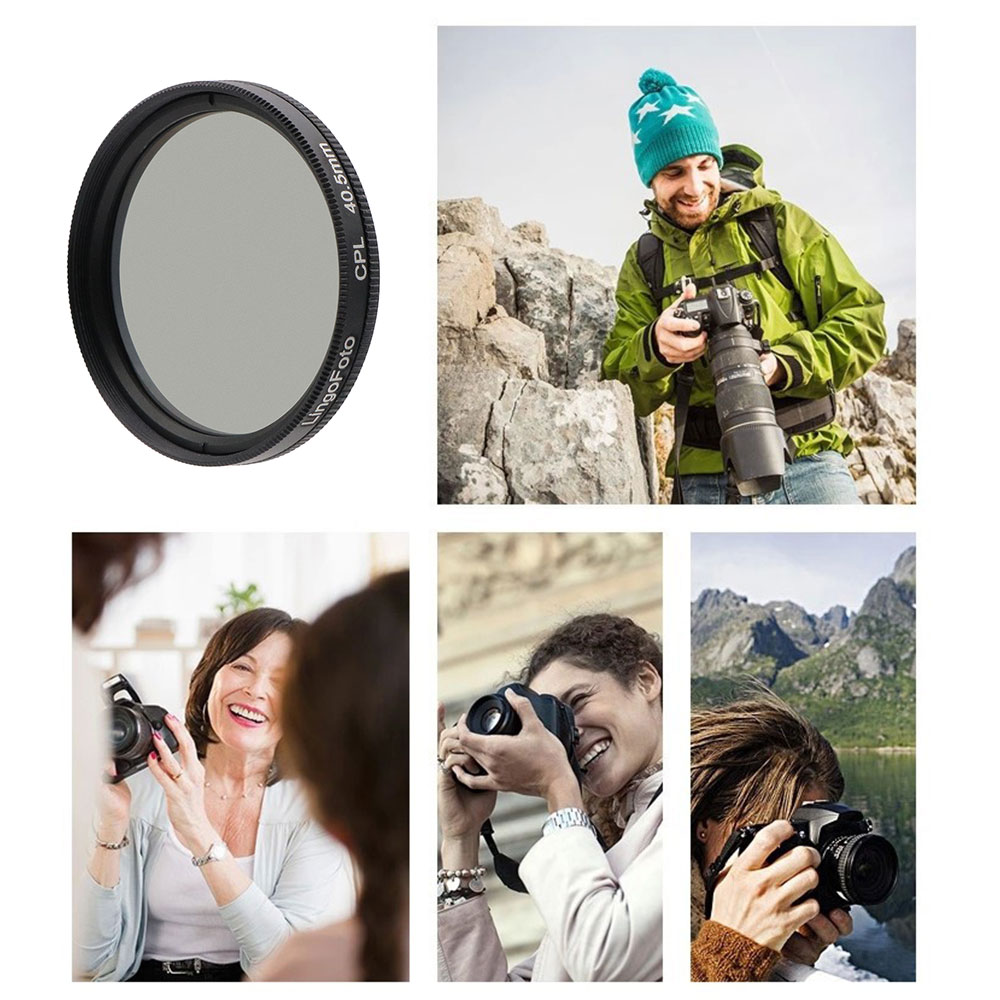
These CPL filters feature an aluminum frame with optical glass. They're non-coated and non-waterproof—basic, solid construction that gets the job done without fancy extras. The optical glass ensures you're not sacrificing image quality, and the aluminum frame keeps things lightweight and durable.
Got Questions? We've Got Answers.
Q: What's the difference between a CPL and a UV filter?
A: A UV filter is mostly for protection—it sits on your lens and guards against dust, scratches, and bumps. A CPL is a creative tool. It actively changes how your image looks by reducing glare, deepening skies, and boosting contrast. You can leave a UV filter on all the time. A CPL is something you put on when you want a specific effect.
Q: Is this hard to use?
A: Not at all. Screw it onto your lens. Look through your viewfinder or at your screen. Rotate the front ring until you see the effect you want. That's it. The first few times you'll probably spin it back and forth a bit, but you'll quickly get a feel for it.
Q: Will a CPL make my photos darker?
A: Yes, a little. Polarizers block some light—about 1 to 2 stops worth. Your camera's meter will compensate automatically, but you might notice slightly slower shutter speeds. In bright conditions, it's rarely an issue. In low light, you might want to take it off.
Q: Can I leave it on all the time?
A: You could, but most photographers don't. Because it cuts light and affects skies and reflections, it's not ideal for every situation. For indoor shots, portraits, or low-light scenes, you're better off removing it. For landscapes, water scenes, or bright sunny days—absolutely leave it on.
Q: What does"non-coated"mean for a CPL filter?
A: It means the glass doesn't have extra anti-reflection or water-repellent layers. In most conditions, you won't notice a difference. The main trade-off is that an uncoated filter might show a bit more lens flare if you shoot directly into bright light. For general use, these filters do their job perfectly well.
Q: Will this work on my wide-angle lens?
A: Yes, but there's one thing to know. Wide-angle lenses capture a very broad view, and because a CPL's effect depends on the angle of the sun, you might see uneven darkening in the sky—one part darker than another. This is normal physics, not a filter issue. You can minimize it by choosing your angle carefully.
Q: How do I know which size to buy?
A: Look at your lens or adapter tube. Find the"Ø"symbol followed by a number—like Ø 58mm. That's your size. Match it to the product (e.g., LC5206 for 58mm).
Q: Can I stack a CPL with other filters?
A: Technically yes, but it's not recommended. Stacking filters increases the risk of vignetting (dark corners) and can reduce image quality. If you need protection, consider using a UV filter or a CPL, not both at once.
Q: Is optical glass better than resin for a CPL?
A: For a polarizer, optical glass is generally preferred. It offers better clarity and maintains the polarization effect more consistently. Resin can work, but glass is the standard for quality CPLs.
A CPL filter is one of those tools that, once you try it, you'll wonder how you lived without it. It transforms reflections into transparency, turns dull skies dramatic, and makes colors sing. It's not a filter you use every day, but for landscapes, water scenes, and bright outdoor shooting, it's absolutely essential.
Find your size, screw one on, and start seeing the world through a different lens—one with deeper blues, richer greens, and zero glare.


